Why a Broken Garage Door Spring Is Dangerous, and What to Do
The spring above your door does the real lifting, and when it lets go, the whole system changes in a second.
October 1, 2026 · 4 min read
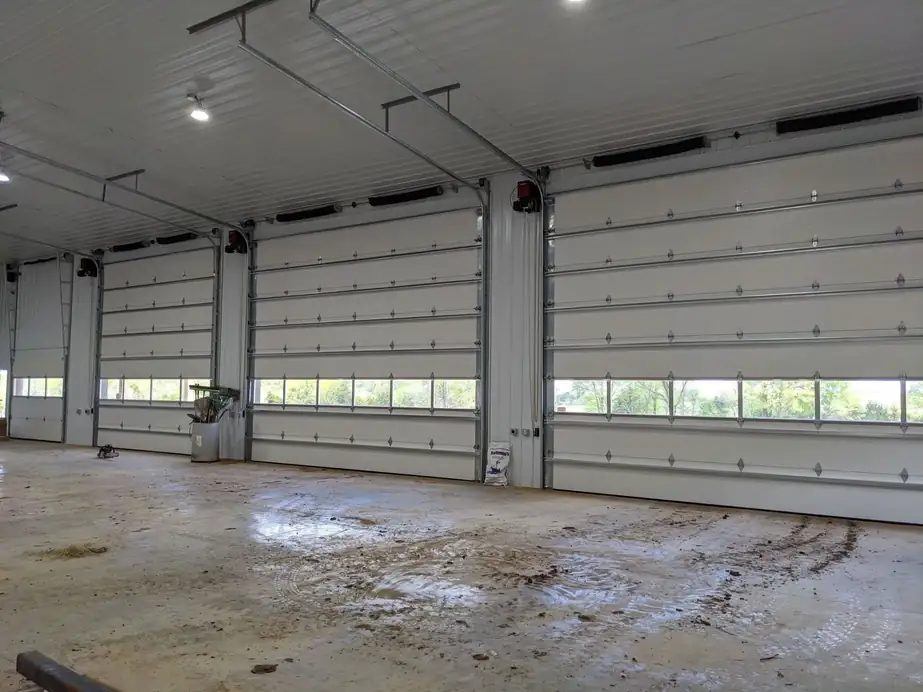
Your garage door is the largest moving part in the house, and it is held up by a part most people never think about. On a typical home in Springdale, Rogers or Bentonville, one or two torsion springs mounted on a steel shaft above the opening do the real lifting. The opener only guides the door along its tracks. When a spring fails, the door goes from feeling light to feeling like a slab of steel, and it happens in a split second.
What the springs actually do
A sectional garage door is heavy. A single steel door is well over a hundred pounds, and an insulated double door or a wood carriage-house style can be a good deal more. The springs are wound tight to counterbalance that weight. Torsion springs twist around a shaft above the door, and cables run from the bottom corners up to drums at each end of that shaft. As the door rises, the springs unwind and the drums take up cable. As it comes down, the drums let the cable out and the springs wind back up. A well-balanced door feels nearly weightless and will often sit halfway open on its own.
Some older or lighter doors use extension springs that run alongside the horizontal tracks. They work on the same idea, stretching instead of twisting, and they should have a safety cable threaded through each one so a broken spring does not whip across the garage.
Why springs fail
Springs are built for a limited number of open-and-close cycles. A household that leaves and returns several times a day uses those cycles much faster than one with a rarely driven second car. Arkansas adds its own wear. Humidity encourages rust on the coils, and a cold morning followed by a warm afternoon makes the steel work harder. A spring that has rusted or dried out usually gives up sooner than it should.
Eventually the metal fatigues and the spring snaps. The bang is loud enough that people inside the house often assume something fell off a shelf. What you heard was a tightly wound spring releasing all its stored energy at once.
Signs a spring is on its way out
- A loud bang from the garage, followed by a door that will not lift
- A visible gap in the coil of the torsion spring above the door
- A door that feels much heavier than it used to, or that rises crooked with one side ahead of the other
- Cables hanging slack or loose at the drums
- An opener that strains, groans, or reverses partway up
- Rust, stretched coils or frayed strands on the spring or cables
Any one of these is worth a phone call. A spring that is visibly rusted is not a spring you want to wait on.
Why this is not a weekend project
A wound spring holds enough energy to injure someone badly. Replacement means fitting steel winding bars into the spring's winding cone and turning it in controlled quarter turns. A slip during that step can send a bar flying. The new spring also has to match the weight and height of your particular door. A spring that is too weak will not balance the door, and a mismatched one wears out the cables and the opener. Cables are tied to the same stored energy, so they belong in the same category: leave them alone.
What to do when one breaks
Stop using the door. Do not keep pressing the wall button, because the opener can burn itself out trying to lift a door that has lost its counterbalance. Keep children and pets out of the garage, and never stand under a door that is partly open. If a vehicle is inside, leave it there until the door has been looked at. Do not try to force the door up by hand.
Then call a technician. Integrity Overhead Door repairs garage doors of all brands and installs LiftMaster openers, and broken springs are a regular part of residential repair work. Our office is open Monday to Friday, 8am to 5pm, and closed Saturday and Sunday. For emergencies we are available 24/7, though after-hours calls carry an additional fee and dispatch depends on a technician being in or around your area.
Replace in pairs and check what is around them
On a door with two torsion springs, the second one is the same age as the first and has done the same number of cycles. Technicians commonly replace them as a pair so the door stays evenly balanced. While the door is being worked on, a careful tech also looks over the cables, drums, rollers and bearing plates, because a frayed cable strand or a worn roller is often the next thing to fail.
If you hear a bang from the garage, or your door has started to feel heavy, call Integrity Overhead Door at (479) 238-2493 or request a quote through this site.
Integrity Overhead Door, (479) 238-2493
Call (479) 238-2493More articles
Repair or Replace Your Garage Door? How to Decide
Most single-part failures are repair jobs, and a few situations make a new door the smarter move.
Garage Door Storm Damage in Arkansas: Safe First Steps
After a storm, the right first five minutes keep you safe and make the repair go faster.